New Eurocode 4 sets new standards for efficient and sustainable steel–concrete design

A new edition of Eurocode 4 has been released, providing updated guidance for designing composite steel–concrete structures that are commonly used in buildings and infrastructure throughout Europe. Published on 18 March 2026, the standard explains how engineers should approach the design of systems that combine steel and concrete, a method widely adopted in more than three-quarters of multi-storey office buildings in the UK, as well as in many high-rise and bridge projects worldwide.
The revised document was developed by a panel of experts from 34 countries and incorporates the latest research and construction practices. It places particular emphasis on improving efficiency, minimizing material usage, and reducing the carbon footprint of construction.
Among the updates are new provisions covering modern building techniques, including beams with web openings, shallow floor solutions, and the use of precast concrete elements. The guidance on shear connections—key components that allow steel and concrete to function together structurally—has also been refined.
Professor Stephen Hicks from the University of Warwick, who chaired the European committee behind the revision, noted that this latest version builds on over five decades of development, including significant contributions from research carried out at Warwick.
Furthermore, the standard introduced design approaches tailored to newer construction methods, e.g. advanced composite systems used in tall buildings and innovative applications like modular nuclear facilities. Overall, the updates are expected to allow for longer and lighter spans, reducing the amount of steel required and helping to lower both construction costs and carbon emissions.
Eurocode 4 is part of the broader Eurocodes system, a unified set of European design standards that ensures safety and consistency in construction across the region. While they are widely applied in public infrastructure projects. Composite steel–concrete systems can be seen in landmark structures such as the Millau Viaduct in France, the Øresund Bridge linking Denmark and Sweden, and iconic skyscrapers like London’s Shard.
Sources: constructionbriefing.com, eurocodes.jrc.ec.europa.eu, eurekalert.org
Want to read more like this story?
Concrete Structures
Jan, 01, 2019 | EducationConcrete structures are constructions that utilize concrete as the primary building material. Conc...
Steel Structures
Jan, 01, 2019 | EducationThe term “steel structures” refers to constructions that rely primarily on steel as the main build...
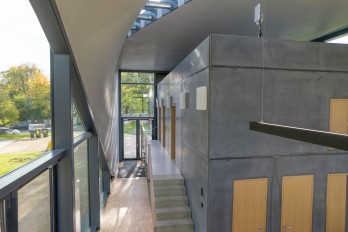
The world’s first carbon concrete building constructed by researchers in Germany
Nov, 10, 2022 | NewsThe first building made of carbon-reinforced concrete was inaugurated in September after two and a...

New system to construct a bridge span in 3 days
Aug, 01, 2018 | NewsA quick deployable bridge system was presented by the University of Maine Advanced Structures and Co...

The future of steel production and steel structure construction
Nov, 27, 2022 | NewsThis article will explore four technologies that are helping shape the future of steel construction...

Vancouver fire hall achieves Zero Carbon emissions
Aug, 06, 2021 | NewsAs the Canada Green Building Council’s Zero Carbon Building Program is on the act, the city of Vanc...

Zero-cement concrete will reduce the environmental impact in construction industry
Aug, 08, 2024 | NewsDue to the climate crisis and the high CO2 emissions of concrete, engineers and scientists are seek...

Steel or Timber? Carbon footprint of truss structures can be reduced with the aid of new studies
Nov, 29, 2021 | NewsBuildings contribute significantly to global warming, not just in their ongoing operations but in t...

The longest 3D-printed concrete bicycle bridge
Sep, 09, 2021 | NewsThe Dutch city of Nijmegen has now the longest concrete 3D-bicycle bridge in the world. The length...
Trending


4.1 magnitude earthquake in Nice, France raises concerns among authorities

The first building in Toronto, Canada to exceed 100 storeys.

The tallest structure in Indiana: 1,132 feet tall

Sinkholes Found Near Lotte World Tower

Three-storey building collapses in Benetússer after residents flee warning signs