Topology optimization for manufacturable 3D-printed concrete structures
Concrete is the most used construction material worldwide, but its production is also one of the largest contributors to global carbon emissions. One innovative approach to reducing its environmental impact is 3D concrete printing, where concrete is deposited layer by layer, much like a large-scale icing dispenser. Unlike conventional construction methods, this process eliminates the need for labor-intensive formwork and places material only where it is structurally required, reducing waste and improving efficiency.
Despite these advantages, many of the highly efficient structures generated through computational design cannot be produced using current 3D concrete printing technology. Engineers often rely on topology optimization, a design method that identifies the strongest possible structure while using the least amount of material. However, these optimized designs usually feature complex, web-like geometries that exceed the capabilities of existing concrete printers, which are limited by nozzle size, turning radius, and the requirement to print continuously without interruptions.
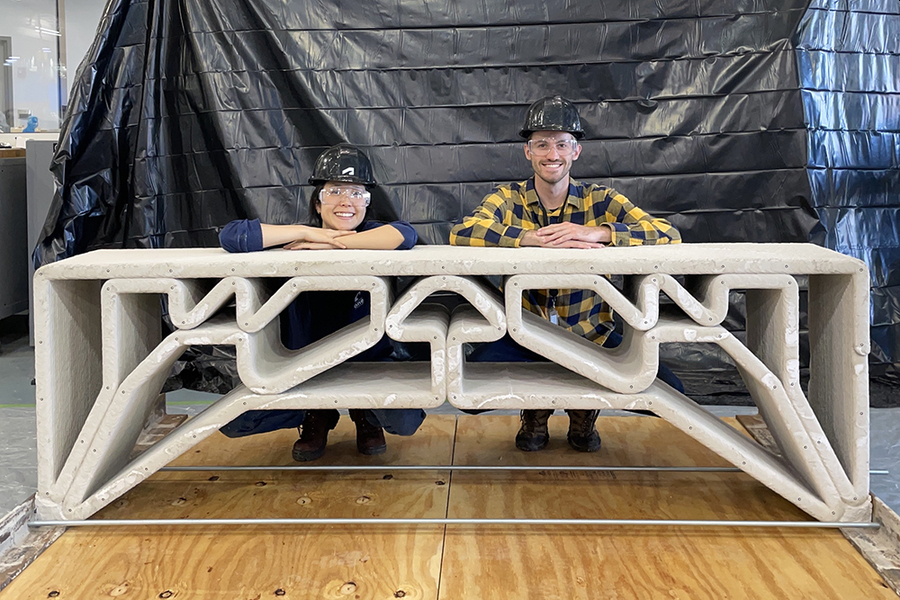
To overcome this challenge, researchers at the Massachusetts Institute of Technology (MIT) have developed a new design framework that integrates the physical constraints of 3D concrete printers directly into the optimization process. Published in Additive Manufacturing, the framework generates designs that are both structurally efficient and immediately printable, eliminating the need for extensive manual modifications. The team demonstrated the approach by designing, printing, and testing a 2.3-meter-long concrete bridge, ultimately showing that current printing hardware—not the concrete itself—is the main factor limiting how lightweight these structures can become.
According to co-first author Hajin Kim-Tackowiak, a postdoctoral researcher in MIT's Department of Civil and Environmental Engineering, previous attempts to transform mathematically optimal designs into manufacturable structures exposed significant gaps between theory and practice. These challenges motivated the team to develop a solution that better aligns computational optimization with real-world fabrication capabilities.
To better understand the practical limitations of large-scale concrete printing, the researchers participated in the Autodesk Research Residency Program, where they collaborated directly with engineers operating industrial 3D concrete printers at Autodesk's Technology Center in Boston. Through these discussions, they identified three critical manufacturing constraints: the minimum width of each printed concrete bead, the limited turning capability of the printer nozzle, and the need to print the entire structure as one continuous path. These practical considerations were then incorporated directly into the mathematical optimization model.
Traditional workflows typically optimize a structure's geometry first and then spend considerable time modifying it to make it printable, a process that can require days of computational post-processing. By comparison, the new framework produces fully printable designs in approximately two minutes on a standard laptop. During the bridge fabrication, when the team needed to slightly reduce the bridge's dimensions, they simply reran the optimization and generated an updated design within five to ten minutes.
Co-first author Zane Schemmer explained that achieving this level of computational speed has only recently become possible due to advances in optimization algorithms. The framework relies on mixed-integer optimization, a mathematical technique that was previously considered too computationally demanding for problems of this scale. Improvements in modern solvers have now made it practical for addressing complex manufacturing constraints in structural design.
To validate their framework, the researchers printed a 2.3-meter concrete bridge using commercially available mortar. The printing process took approximately 30 minutes. Structural testing demonstrated that the bridge, weighing around 900 pounds, successfully supported more than 2,000 pounds of distributed load while exhibiting almost no measurable deflection, closely matching the researchers' computational predictions.
Perhaps the study's most significant finding was that the bridge proved to be substantially over-engineered from a structural perspective. The researchers discovered that, for most practical loading conditions, the design was governed almost entirely by the limitations of the printing process rather than by the strength of the concrete itself. In other words, current manufacturing constraints, rather than material performance, determine how efficiently these structures can be designed.
Because the framework identifies the mathematically optimal solution, it also enables researchers to evaluate how individual printer limitations influence material consumption. This capability provides valuable guidance for future printer development by quantifying the benefits of specific hardware improvements.
Among all the manufacturing constraints examined, the width of the printed concrete bead had the greatest impact. The bridge was printed using a bead width of four centimeters, but simulations showed that reducing this width to just one centimeter could decrease material usage by as much as 76% while still satisfying structural safety requirements. Interestingly, the researchers initially expected the continuous-printing requirement to have the greatest influence, but the bead width proved to be the dominant factor.
These findings provide a clear direction for future improvements in 3D concrete printing technology. Relatively modest enhancements to printer hardware could significantly improve material efficiency, reduce concrete consumption, and ultimately lower the carbon footprint of construction.
An important feature of the bridge design is that every component remains under compression. Since concrete performs exceptionally well under compressive forces but poorly under tension, the optimization framework ensured that no part of the bridge experienced tensile loading during normal operation. This compression-only strategy contributed to the bridge's excellent structural performance during testing.
The benefits of this approach extend beyond reducing material consumption. By eliminating the need for custom molds, 3D concrete printing becomes especially attractive for producing unique or customized structures. The researchers believe this technology could be particularly valuable in disaster relief situations, where critical infrastructure could be constructed rapidly without the delays associated with manufacturing traditional formwork.
The bridge's reliance on compression was dramatically illustrated after testing. Although it had successfully supported loads exceeding 2,000 pounds, it fractured when a worker lifted one corner slightly to clean underneath it. The failure occurred because lifting introduced tensile forces that the bridge was never designed to resist. Rather than indicating a flaw in the design, this outcome reinforced the fundamental principle that concrete structures optimized for compression remain highly vulnerable when subjected to tension.
The research team is now extending this work toward reinforced concrete structures. Since most practical construction incorporates steel reinforcement to resist tensile forces, the next objective is to integrate reinforcing bars (rebar) into the 3D printing process. However, developing methods to place reinforcement within printed concrete remains a significant technical challenge.
The study was funded by the National Science Foundation with additional support from the MIT Center for Advanced Production Technologies. The research team included Hajin Kim-Tackowiak, Zane Schemmer, Josephine Carstensen, Pittipat Wongsittikan, and Jackson Jewett.
Sources: news.mit.edu, lifeboat.com, reddit.com
Media
- Watch a 2.3-meter concrete bridge take shape, 3D printed layer by layer
Want to read more like this story?

The longest 3D-printed concrete bicycle bridge
Sep, 09, 2021 | NewsThe Dutch city of Nijmegen has now the longest concrete 3D-bicycle bridge in the world. The length...

World’s first 3D-printed concrete cycle bridge opens in the Netherlands
Oct, 23, 2017 | NewsLast Tuesday, October 17th, the Netherlands inaugurated the world’s first 3D-printed concrete bridge...
Concrete Structures
Jan, 01, 2019 | EducationConcrete structures are constructions that utilize concrete as the primary building material. Conc...

World’s largest and longest 3D-printed concrete bicycle bridge: some observations 4 years after its construction
Aug, 11, 2023 | NewsThe BAM construction group constructed the largest and most extensive concrete bridge using 3D prin...

New solution promises 90% cost reduction in concrete 3D printing materials
Dec, 22, 2021 | NewsConcrete 3D printing of building shells has grown considerably in the last few years, with more and...

How Japan’s first two-story 3D-printed home is built for earthquakes
Mar, 01, 2026 | NewsIn Miyagi Prefecture, a small two-story home built mostly with 3D-printed concrete has reached an i...

A 29-meter-long 3D printed bridge is under construction in the Netherlands
Apr, 05, 2021 | NewsThe world's longest 3D printed pedestrian concrete bridge is currently under construction in the...

Dubai plans to build the world's first 3D-printed mosque
May, 03, 2023 | NewsDubai aspires to build the world's first 3D-printed mosque, that will cover an area of 2,000 square...

The world’s most exceptional 3D printed homes
Apr, 10, 2024 | News3D printing technology is a revolution at the construction sector, enabling builders to fabricate h...
Trending


4.1 magnitude earthquake in Nice, France raises concerns among authorities

The first building in Toronto, Canada to exceed 100 storeys.

The tallest structure in Indiana: 1,132 feet tall

Sinkholes Found Near Lotte World Tower

Three-storey building collapses in Benetússer after residents flee warning signs

The tallest European bridge built in France