The tallest European bridge built in France
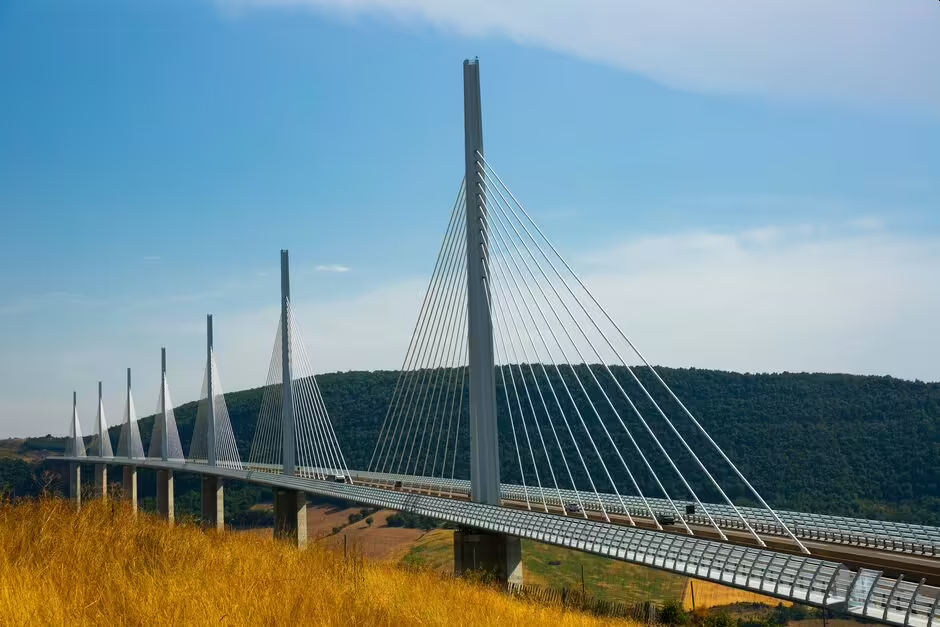
The Millau Viaduct is the tallest bridge in Europe, reaching an astonishing height of 343m. This height is tall enough for an entire skyscraper to fit beneath it. Although many people might expect such an engineering marvel to be found in countries like China or the United States, it is in Europe and specifically in France.
The bridge designed by renowned British architect Sir Norman Foster and completed in 2004 with a total cost of approximately €394 million. It is noted that the bridge carries motorway traffic between Paris and the Mediterranean, making travel through the region much faster by bypassing the town of Millau.
Standing even higher than the Eiffel Tower, which measures 330m, the Millau Viaduct stretches 2,460m across the Tarn Valley. Its elegant design allows it to touch the valley floor only nine times, minimizing its environmental footprint and creating a striking visual landmark.
Plans for a crossing over the Tarn Valley first emerged in the 1980s to ease heavy traffic in Millau. According to Le Shuttle, the viaduct was chosen as the best solution because it could span the valley and river with the least ecological impact. Construction officially began in 2001 and was completed just three years later.
As the bridge functions as a major high-speed motorway, pedestrians are not allowed to walk across it. However, it remains a popular tourist attraction. Visitors can take guided tours that follow a scenic nature trail to an observation point beneath the bridge, and some tours even offer access inside one of its towering pylons. The viaduct has also become the venue for an annual marathon, while the Tour de France has passed beneath it several times.
One of the bridge's most distinctive features is its subtle curve, which extends over roughly 20km of the connecting roadway. Engineers introduced this gentle bend to prevent drivers from experiencing the unsettling feeling of floating that can occur on long, perfectly straight bridges. The roadway also has a slight 3% incline, improving visibility and enhancing driver confidence. In addition, the bridge is built to withstand challenging weather conditions, including powerful winds reaching speeds of up to 151 km/h. To improve safety, protective side screens were installed, reducing the force of crosswinds by around 50%.
Visitors consistently praise both the bridge and its breathtaking surroundings. Many describe it as an extraordinary feat of engineering, recommending that travelers view it from below to fully appreciate its immense scale. Others highlight the spectacular scenery, saying the landscape feels like stepping into a painting. The nearby visitor center, free parking, and short walking trail to the observation point make it easy to enjoy panoramic views before experiencing the unforgettable drive across one of the world's most impressive bridges.
Sources: express.co.uk, mirror.co.uk, en.wikipedia.org
Media
- The Bridge That Took 14 Years to Build — And Changed How We Build Everything
Want to read more like this story?

Hussaini suspension bridge: Pakistan’s most dangerous crossing
Jan, 04, 2026 | NewsAround the world, there are remarkable examples of modern engineering that showcase human ingenuity...

World's most frightening bridges to cross: Part 1
Mar, 20, 2020 | NewsBridges are structures that enable crossings over physical barriers including rivers, valleys and c...

The most famous bridges of the world
Aug, 26, 2015 | NewsThere are so many bridges in the world in different styles, like old stone bridges or steely, footbr...

Types of bridges
Jun, 01, 2023 | EducationArch Bridge An arch bridge is a type of bridge that uses a curved, semi-circular structure, kno...

World's most frightening bridges to cross: Part 2
Mar, 21, 2020 | NewsBridges have been part of engineering features since ancient times. Through the ages, their design...

Interesting bridges around the world
Mar, 20, 2017 | NewsEach one of them is unique in its own way! 1. Sidu River bridge,...

Multi-Modal Bridge Being Built in Portland Bans Cars
Aug, 25, 2014 | NewsConstruction is currently underway on the country’s first multi-modal bridge that bans private cars....

10 of the longest floating bridges worldwide
Apr, 24, 2024 | NewsConsidered feats of modern engineering, floating bridges play a crucial role in areas where underwa...
Historic Oregon Bridge For Sale
Aug, 15, 2014 | NewsIf anyone is in the market for purchasing an old bridge here is your chance. Multnomah county i...
Trending


4.1 magnitude earthquake in Nice, France raises concerns among authorities

The first building in Toronto, Canada to exceed 100 storeys.

Europe's 'longest bridge' which cost £746.5m to build

Sinkholes Found Near Lotte World Tower

Aman brings signature luxury to Singapore's first supertall skyscraper

7.1-magnitude quake damages historic Kumamoto Castle under restoration