AI-assisted bridge featuring 3D-printed steel connections wins 2026 German steel construction award
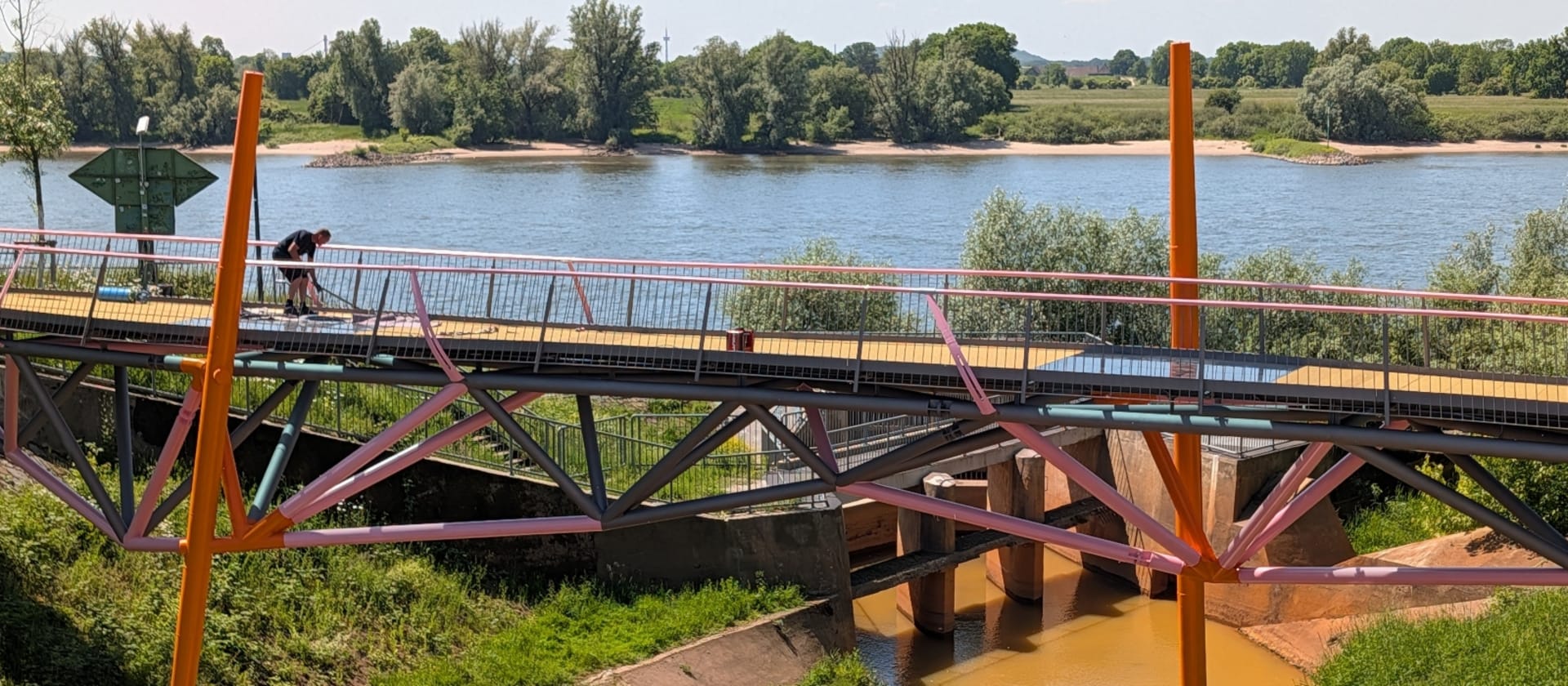
Kleine Emscher Pedestrian and Cycling Bridge in Germany won the 2026 German award because of its unusual design and use of advanced steel manufacturing techniques.The award was given to Winterhalter Stahlbau, which constructed the bridge across the Kleine Emscher River in North Rhine-Westphalia while it was designed by architecture professor Thomas Spiegelhalter
It should be noted that the 50-metre-long bridge has an asymmetric steel framework made from hollow steel sections. In addition, it has six specially developed stainless-steel joints connect its main structural members. In order to manufact the steel connections they used 3D printing using laser metal deposition, a technique that gradually builds up metal into the required shape.
Moreover, Spiegelhalter combined AI-assisted generative design with evolutionary algorithms to study different arrangements of the steel members and develop the complex shapes needed for the connections. Then, the engineers used finite element analysis to assess the structural performance of the proposed design.
Although Spiegelhalter has designed several award-winning bridges, this was his first project to bring together these computational methods and robotic metal manufacturing. He described the work as the result of years of cooperation between architects, engineers, researchers and construction specialists.
One of the biggest challenges was ensuring that the 3D-printed connections could be used safely in a permanent public structure. Their development involved extensive testing and a lengthy technical approval process. Engineers Matthias Pfeifer and Bernd Sum contributed to the project, while the Karlsruhe Institute of Technology was involved in testing the connections.
The bridge was assembled by Winterhalter Stahlbau in just two days. Further work included welding, painting and laying the deck surface. Three sections of the walkway are made from glass, allowing people crossing the bridge to see parts of the supporting steel structure, including the printed joints.
The crossing forms part of the Green Window to the Rhine project, which is redeveloping a former industrial area into a public park. It is located near the Kleine Emscher River, where restoration work has improved water quality and the surrounding environment.
The bridge's design also considered the conditions of the site. Environmental surveys examined local plants and wildlife to help limit disruption during construction. Structural assessments accounted for wind loads and the forces that could act on the bridge during periods of flooding.
While most of the bridge was built using familiar steel construction methods, its specially printed connections show how additive manufacturing can be introduced into larger structural projects without replacing conventional fabrication entirely. The bridge also provides a practical example of how computer-generated designs can be developed, tested and manufactured for use in public infrastructure.
In all, the project is expected to open to pedestrians and cyclists before the end of 2026.
Sources: communitynewspapers.com, https://news.fiu.edu/2026/fiu-architecture-professor-bridges-design-and-construction-to-earn-german-steel-construction-award
Want to read more like this story?

Spectacular interchanges around the world
Jun, 20, 2018 | NewsCheck these engineering marvels, built to provide solutions to chronic traffic congestion problems...

Cairo, Egypt: Building collapse caused 6 casualties while 7 others were injured
Oct, 13, 2026 | NewsOn Tuesday October 13, a five-storey building collapsed in Cairo's Hadayek El-Qobba district, killin...
Kyrgyzstan plans record-breaking glass suspension bridge in Ala-Archa National Park
Nov, 05, 2026 | NewsA new project is about to begin in Kyrgyzstan that could set a new world record and become a major a...
New AI system identifies multiple defects in concrete bridges using photographs
Nov, 06, 2026 | NewsA major matter for the engineers is that inspecting concrete bridges is not always straightforward,...

Severe storms and possible tornadoes cause widespread damage across North Carolina
Oct, 15, 2026 | NewsSevere thunderstorms and possible tornadoes swept through central North Carolina on Sunday, knocking...

China: Hangzhou Bay cross-sea railway bridge reaches major construction milestone
Oct, 23, 2026 | NewsThe southern navigation channel bridge of the Hangzhou Bay Cross-Sea Railway Bridge reached a major...
Glass cafe at 2,600 feet in the air: it opens on world's tallest bridge
Oct, 13, 2025 | NewsThe Huajiang Grand Canyon Bridge was completed in three years and eight months and now links two ma...

Shipyard Crane Fatigue Analysis with FEA and SDC Verifier
Oct, 08, 2026 | NewsWhere the crane details were exposed to variable-amplitude loading, SDC Verifier used the Palmgren-M...
MIT engineers test new fabric-cast concrete beams that require less concrete
Nov, 18, 2026 | NewsEngineers at the Massachusetts Institute of Technology (MIT) have tested a different way of producin...
Trending

Western Australia: Construction of the tallest wind turbines is underway

The Leaning Tower of Pisa: Ingenious design and ongoing stability efforts

Newcastle’s tallest building reaches its final height

Complex underground tunnel in Manhattan: The Grand Central–42nd street connection
Western Australia: Construction of the tallest wind turbines is underway
5.9 magnitude earthquake rattled Indonesia; No fatalities or injured were reported