
MIT engineers test new fabric-cast concrete beams that require less concrete
- Nov, 18, 2026
- Structural Design Multiscale Methods Performance-Based Design Structural Optimization Structure Reinforcement Structural Control Structural Systems Beams Concrete Structures Structural Analysis Structural Stability Structural Behavior Other Structural Sustainable Development News On Research / Academia Other News
- United States, Massachusetts, Cambridge
- Authored by: thestructuralengineer.info
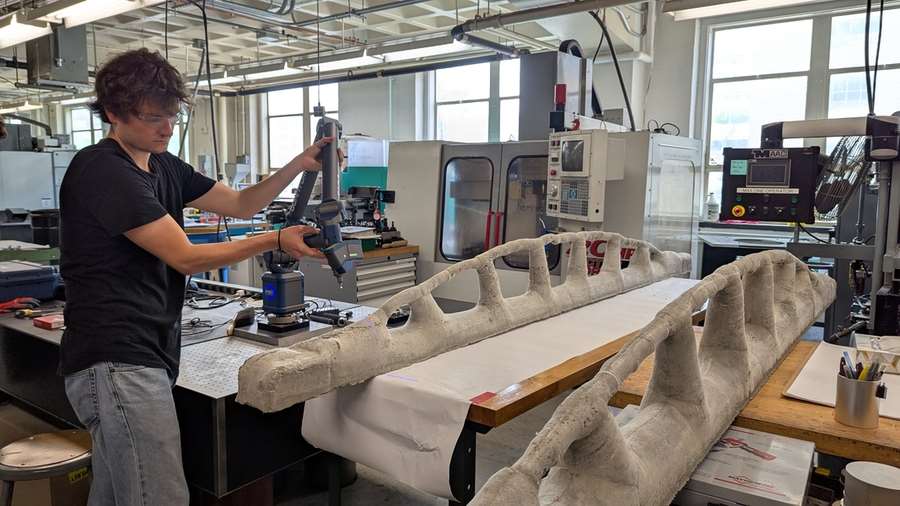
Engineers at the Massachusetts Institute of Technology (MIT) have tested a different way of producing concrete beams, using fabric molds to reduce the amount of material needed without changing the loads the beams are designed to carry.
The researchers manufactured a three-meter-long beam using a specially sewn cotton mold. Compared with a conventional beam designed for the same loading conditions, the new structure used about one-third as much concrete and half as much steel reinforcement. The study was published in the Journal of Building Engineering.
The design combined two computational methods. Graphic statics was used to map a path for the steel reinforcement, shaping the bar so that it carries an equal share of the load along its length and remains simple enough for builders to fabricate. Topology optimization then determined where concrete was needed and where material could be removed from areas contributing little to structural performance. The resulting beam is not a traditional solid shape but has a top section and a thin bottom section connected by narrow, angled legs.
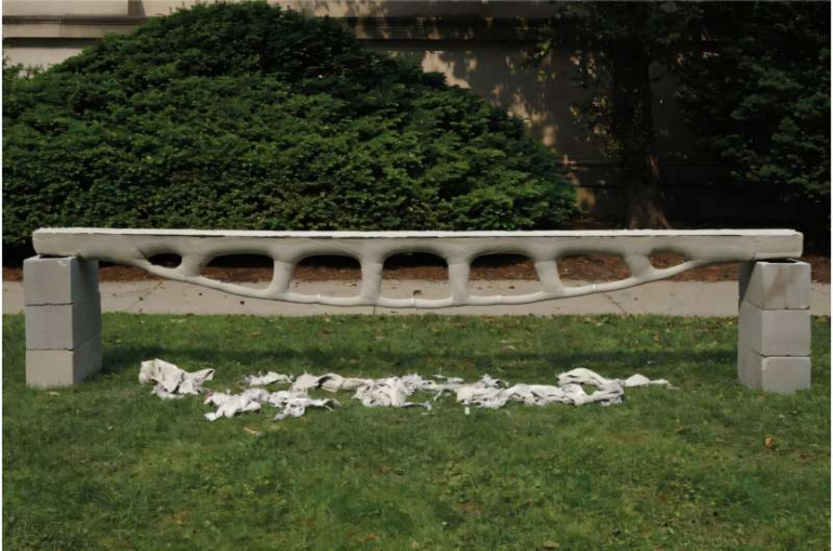
Shapes produced by topology optimization are often too complex or expensive to pour into rigid molds, and the few that have been built have mostly relied on concrete 3D printers or machine-carved molds. The team turned to fabric because it can accommodate irregular shapes, stretching and shifting position as it fills with fresh concrete, and because it is inexpensive, lightweight and quick compared with wood or steel.
An automated process translated the 3D design into flat fabric patterns, with the calculations accounting for how the cotton would stretch and sag under the weight of wet concrete so the team could predict the finished shape.
The pieces were then sewn together and stapled to a simple timber frame. Getting the concrete mix right proved the main practical difficulty: woven cotton lets water seep through, so a mix that is too runny loses water and presses harder against the fabric. The team used a moderately wet, sand-rich mix with only small stones, working from outside the mold by prodding each layer and tapping and kneading the fabric to push concrete through the narrow sections. Because the mold flexes, this could be done without a concrete vibrator, which a rigid mold of the same shape would require.
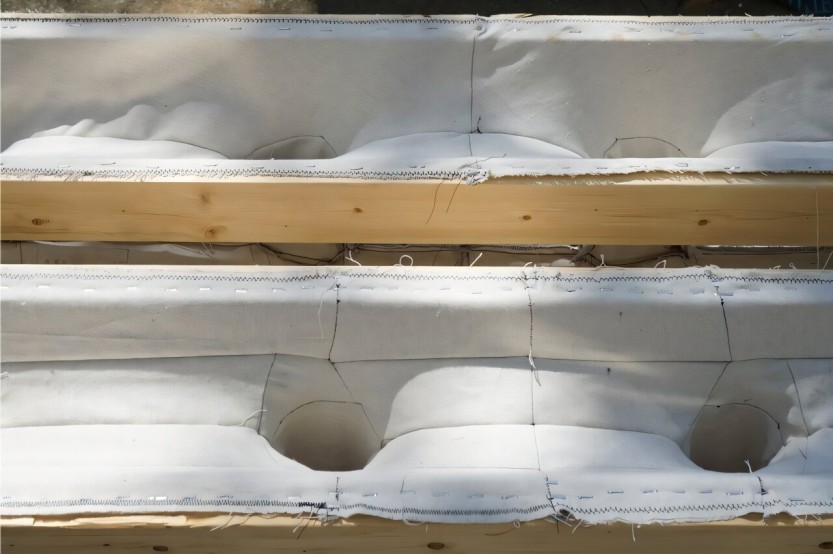
The team produced three versions of the same beam, with molds containing 36, 56 and 76 fabric pieces, allowing the engineers to compare how accurately each arrangement reproduced the design and how much effort was needed to assemble it. All three came out free of wrinkles and creases.
The 56-piece mold proved the most practical, capturing the important design geometry without the additional sewing work and accumulated assembly errors associated with the more complex pattern.
The researchers also carried out an initial loading test, placing 36 water-filled buckets on one specimen to apply a load equivalent to roughly 30% of its design capacity, reflecting everyday service conditions. Measured deflection at midspan was within approximately 2% of the predicted value. Although encouraging, the experiment did not establish the beam's ultimate strength, and further testing is planned to load multiple beams to failure.
The amount of material saved was substantial, but manufacturing costs presented a separate challenge. Because the cotton molds had to be cut and sewn, the process required more labor than conventional formwork, and whether the technique is economical depends partly on where the beams are made.
Using estimated construction costs for the Global South, the team calculated that producing a single beam could be between 10% and 20% cheaper than the conventional alternative. Under the higher labor costs considered for the Global North, however, the same approach was estimated to cost between 16% and 55% more.
These differences suggest that fabric formwork is best suited to one-off or small-batch components whose shape would otherwise require expensive custom molds, with the researchers identifying exposed architectural beams, roof and long-span framing, pedestrian structures and landscape elements as possible applications. For the repetitive rectangular beams found in most buildings, conventional reusable molds remain more economical where labor is expensive.
Although fabric has previously been used to cast concrete elements with varying dimensions, its tendency to deform under pressure has made the process difficult to control. Josephine Carstensen, the Gilbert W. Winslow Career Development Professor in Civil Engineering and senior author of the study, said the key realisation was that this flexibility is not simply a limitation to be managed but, with the right computational pattern design, a way to produce optimized structural forms.
Reducing concrete volume matters because cement production accounts for roughly 8% of human-caused carbon emissions. The number of buildings worldwide is expected to nearly double by 2050, with around 85% of that growth in developing countries where access to advanced construction equipment is often limited, which is why the team pursued a method requiring only a digital pattern, a sewing machine, suitable fabric and a timber frame.
For now, the work remains at an experimental stage. The three-meter beam is described as a proof of concept comparable to a short building span, and scaling up is not simply a matter of enlarging the design, since a longer beam's own weight changes the pressure on the mold. Additional strength tests and improvements to the manufacturing process will be necessary to establish whether the technique can compete with conventional methods in everyday construction.
Sources: sustainability.mit.edu, constructionbriefing.com, techxplore.com
Media
- How Fabric Can Shape Concrete: From Cloth to a Research Beam
Want to read more like this story?

Spectacular interchanges around the world
Jun, 20, 2018 | NewsCheck these engineering marvels, built to provide solutions to chronic traffic congestion problems...

Severe storms and possible tornadoes cause widespread damage across North Carolina
Oct, 15, 2026 | NewsSevere thunderstorms and possible tornadoes swept through central North Carolina on Sunday, knocking...

Cairo, Egypt: Building collapse caused 6 casualties while 7 others were injured
Oct, 13, 2026 | NewsOn Tuesday October 13, a five-storey building collapsed in Cairo's Hadayek El-Qobba district, killin...

Glass cafe at 2,600 feet in the air: it opens on world's tallest bridge
Oct, 13, 2025 | NewsThe Huajiang Grand Canyon Bridge was completed in three years and eight months and now links two ma...

The Leaning Tower of Pisa: Ingenious design and ongoing stability efforts
Jun, 19, 2024 | NewsThe Tower of Pisa, since its completion in 1372, has continually leaned. However, due to intentiona...

Complex underground tunnel in Manhattan: The Grand Central–42nd street connection
Oct, 01, 2026 | NewsThe new pedestrian tunnel connecting Grand Central Terminal with the No. 7 subway line at 42nd Stree...

Athens, Greece: Building collapsed after explosion
Sep, 25, 2026 | NewsAccording to the Greek emergency services, on Friday, September 25, a building in central Athens, lo...

How X1 Wind Accelerated DNV Verification for Floating Wind Platform with Up to 1.2 Million Elements
Sep, 14, 2026 | NewsVerifying a floating wind platform to DNV rules meant eight engineering hours per column — repeated...

Newcastle’s tallest building reaches its final height
Sep, 25, 2026 | NewsNewcastle’s skyline is getting a major addition, with The Store development in the city’s West End o...
Trending


Tulsa’s Williams Crossing Bridge Wins 2026 Bridge of the Year

Shipyard Crane Fatigue Analysis with FEA and SDC Verifier

Dar es Salaam, Tanzania: 13 fatalities due to building collapse

Africa’s longest bridge: Cairo’s Iconic 6th October Bridge

China- North Korea: new bridge over the Yalu River opened to traffic

China: Hangzhou Bay cross-sea railway bridge reaches major construction milestone
