Shipyard Crane Fatigue Analysis with FEA and SDC Verifier Sponsored
Why fatigue is a serious risk in shipyard cranes
Shipyard crane structures include many fatigue-sensitive details and familiar weld fatigue challenges: welded joints, bolted connections, corners, transitions, and local geometry changes. In service, these details are exposed to repeated stress variation from lifting and lowering operations. In a marine environment, that structural demand is compounded by humidity, salt exposure, and temperature changes.
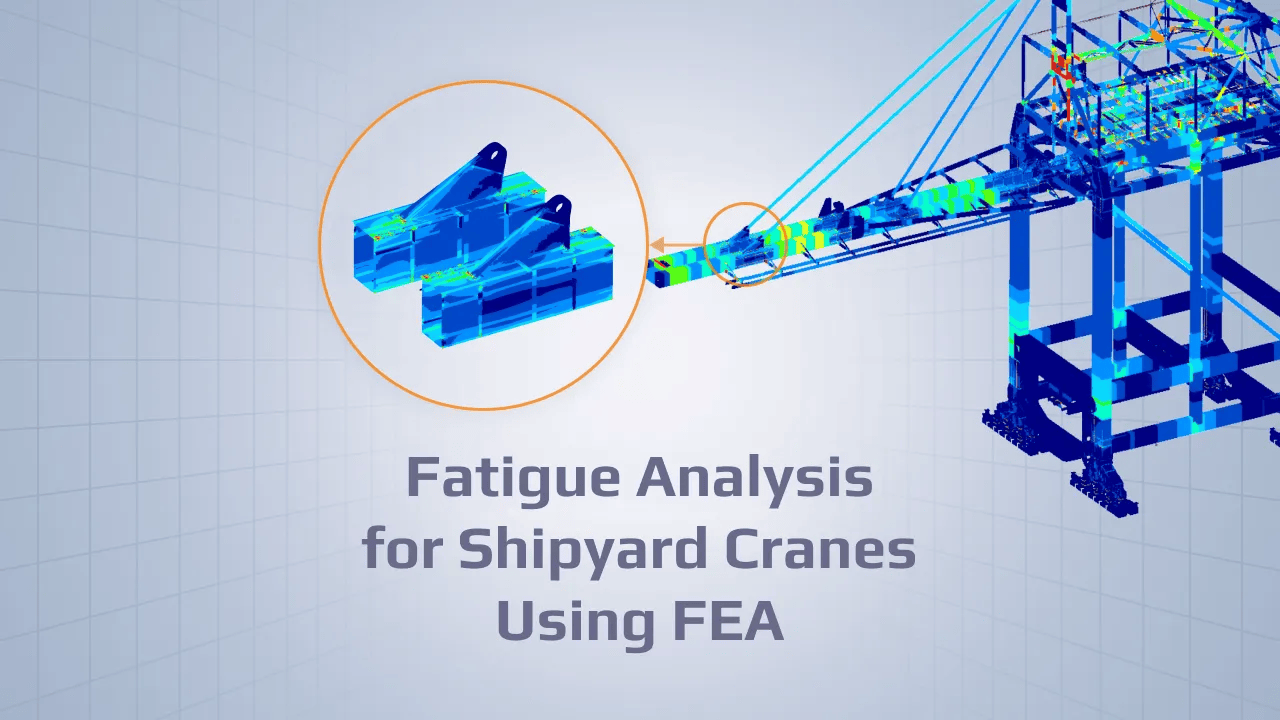
The result is predictable: some areas of the structure carry much higher fatigue risk than others. Stress analysis of the crane highlighted local stress concentration zones, especially around areas with elevated and abrupt structural transitions, such as plate thickness changes and structural interfaces. These are the places where fatigue cracks are most likely to initiate if the design is not checked properly.
The limitation of manual fatigue verification
Fatigue Analysis Workflow: FEA Model and EN 13001-3-1+A2An engineer can perform residual life analysis for crane structures or fatigue calculations manually in Excel, Mathcad, or similar tools. But that approach breaks down quickly when the model includes many structural members, many welded details, and many loading conditions.
Manual methods are workable when one member is checked under one loading condition. They are not efficient when the task is to verify a complete crane model under hundreds or thousands of combinations on top of the general FEA design workflow.
That is where SDC Verifier changes the process. It turns fatigue verification from a fragmented post-processing exercise into a repeatable engineering workflow integrated with the broader structural assessment process.
Fatigue Analysis Workflow: FEA Model and EN 13001-3-1+A2
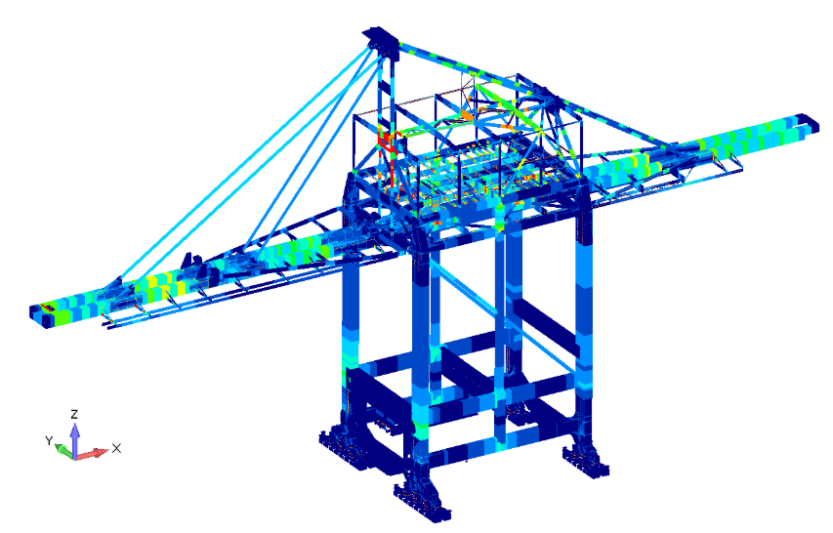
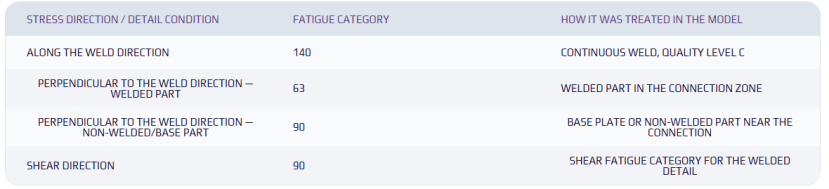
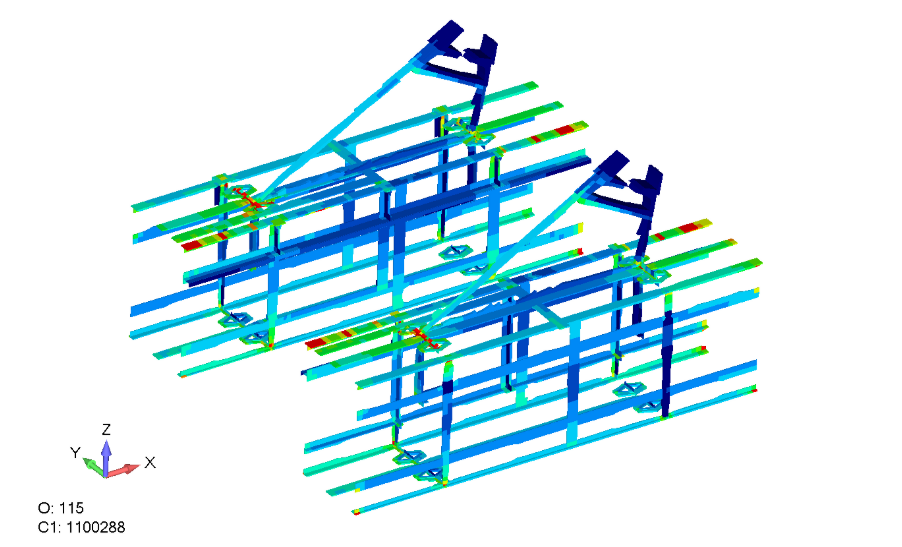
A finite element model of the crane was prepared with special attention to critical welded connections. The FE model was built primarily with shell elements representing the mid-surfaces of the structural plates, together with material data and local mesh refinement in fatigue-sensitive areas. Because the model was shell-based, weld effects were not represented by explicit 3D weld volume. Instead, SDC Verifier introduced weld behavior analytically through weld recognition and fatigue category assignment according to EN 13001-3-1+A2.
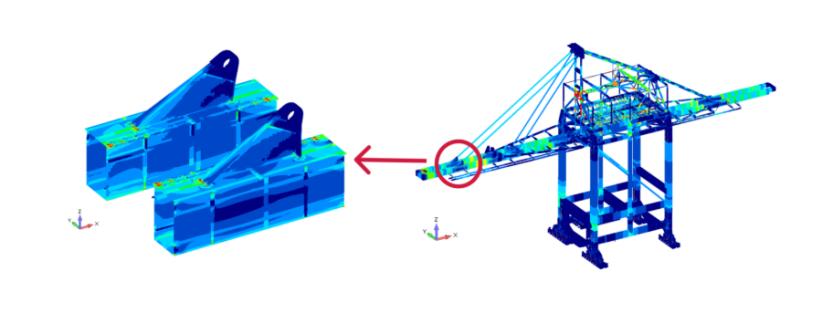
The crane boom connection zone was then extracted from the full FE model for more detailed fatigue assessment. This made it possible to concentrate mesh refinement and fatigue classification on the most critical subcomponents without losing the context of the full structure.
How SDC Verifier supported the fatigue check
One of the main practical advantages in this project was automation.
Based on FEA stress results and principles used in the hot spot stress method for weld evaluation in FEA, SDC Verifier automatically identified fatigue-relevant locations such as weld toes, welded-part interfaces, and abrupt structural transitions. The software also distinguished between welded parts, base plates, and other fatigue-sensitive details so that the correct fatigue categories could be assigned consistently across the model.
For each relevant hotspot, the corresponding fatigue category and S-N curve were applied to estimate fatigue life. In practice, that meant evaluating the same connection detail in separate stress directions and assigning fatigue strength according to the governing local condition. Small geometric changes at welded details can materially change the fatigue life prediction, which is exactly why automatic recognition and consistent category assignment matter.
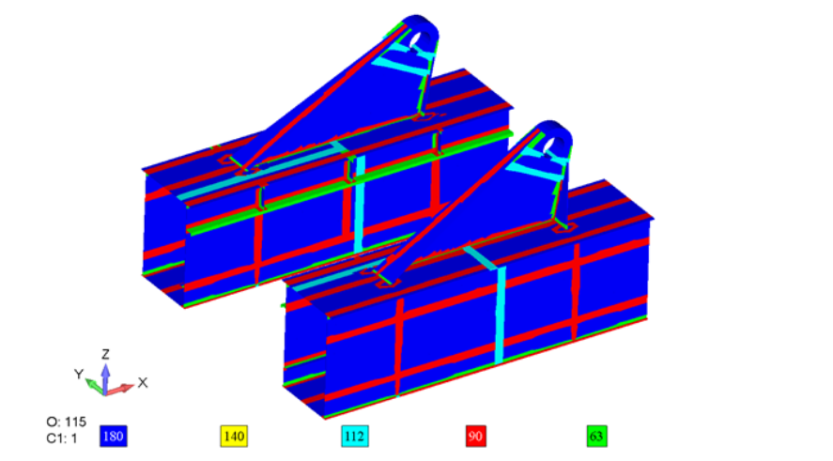
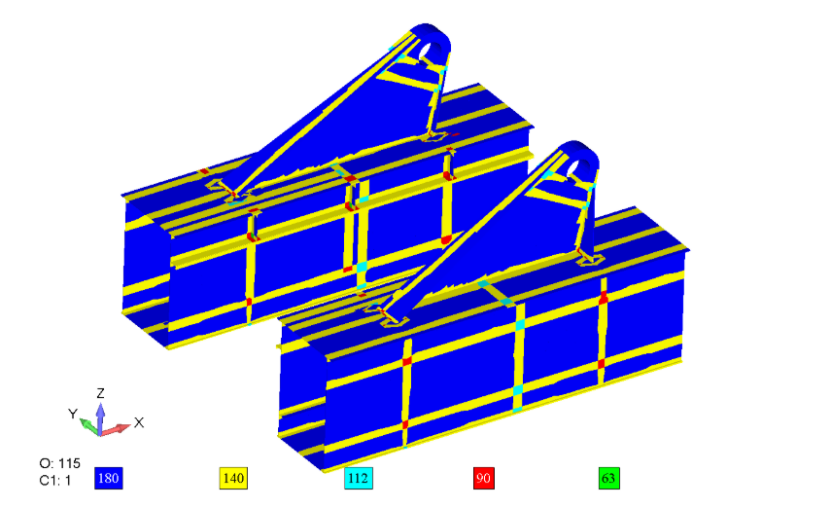
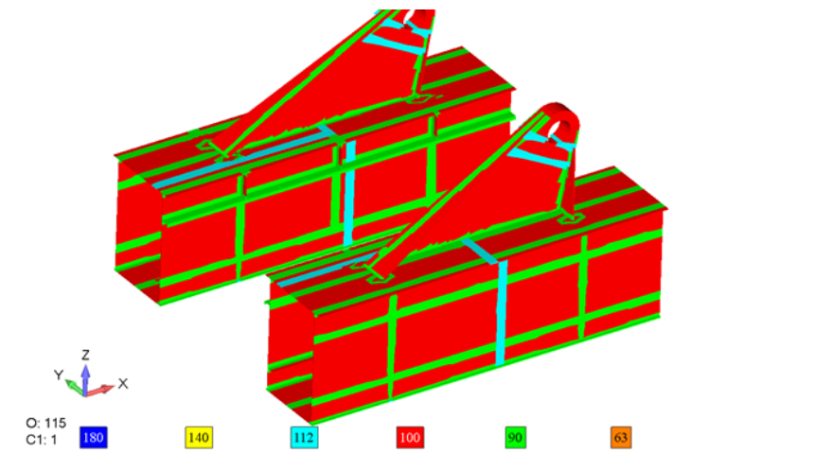
Results and design validation
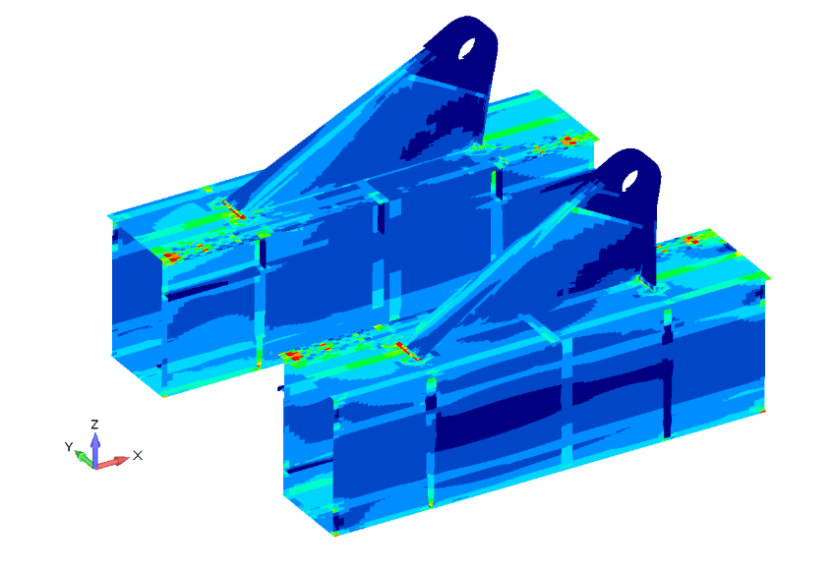
- some details were accepted as designed,
- some required a weld quality upgrade,
- and some were redesigned through local geometric modification.
Why SDC Verifier is more practical than manual fatigue checking
An experienced engineer can calculate fatigue manually in Excel, Mathcad, or similar tools. But that approach usually works for one member under one loading condition at a time. In a shipyard crane, where multiple welded details must be checked across many operating cases, that quickly becomes slow, inconsistent, and error-prone.
Running directly within your FEA environment, SDC Verifier helps engineers:
- verify complete crane models instead of isolated details,
- process hundreds or thousands of loading combinations in one workflow,
- apply EN 13001-3-1+A2 fatigue checks more consistently,
- reduce manual transfer and transcription errors,
- and generate exportable engineering verification reports for review and documentation.
The result is not just faster fatigue analysis. It is broader coverage, more repeatable verification, and a lower chance of missing the local details that govern fatigue life.
Conclusion
This shipyard crane case shows why fatigue verification should not be treated as a disconnected manual exercise.
In welded crane structures, the governing details are often not the obvious ones. Fatigue risk is local, load-history-dependent, and easy to underestimate if the workflow is fragmented. By combining FEA results with automated fatigue checks in SDC Verifier, engineers can identify critical hotspots faster, apply EN 13001 requirements more consistently, and validate fatigue performance across the full structure with less manual effort.
For crane design teams working on heavy lifting structures, that means a more reliable and scalable verification process from FEA results to final design sign-off.
Want to read more like this story?

Fatigue+ Software
Oct, 19, 2023 | Software
SFAT Structural Fatigue Life Software
Jan, 04, 2020 | Software
SDC Verifier 2026 R2 Expands Structural Verification for Offshore, Marine, and Complex Engineering Projects
Sep, 16, 2026 | NewsSDC Verifier 2026 R2 expands structural verification with new offshore and marine standards, multiax...

AutoFEM Fatigue Analysis
Dec, 24, 2013 | SoftwareFatigue
Sep, 16, 2022 | EducationFatigue is the initiation and propagation of cracks in a material due to cyclic loading. Once a fa...

Correct Crane Stiffness Prediction: A Crucial Aspect for Operational Efficiency
Dec, 27, 2024 | NewsAuthor: Wouter van den Bos, Faculty of Mechanical Engineering, Section Transport Technology and Lo...

EN 13001 Compliance and Extending Port Equipment Lifetime with SDC SAM
Jun, 25, 2025 | EventMany port operators and heavy lifting companies still struggle with structural verification — espec...

What’s New in SDC Verifier 2025 R2
Sep, 11, 2025 | EventThis webinar will present a new version of SDC Verifier, the advanced structural verification softw...

Stunning moment a crane crashes down on a construction site in Sydney
Dec, 12, 2019 | NewsA shocking crane collapse occurred on Sunday, December 1, 2019, at a construction site in Sydney, Au...
Trending

Spectacular interchanges around the world

Cairo, Egypt: Building collapse caused 6 casualties while 7 others were injured

Severe storms and possible tornadoes cause widespread damage across North Carolina
Glass cafe at 2,600 feet in the air: it opens on world's tallest bridge

Shipyard Crane Fatigue Analysis with FEA and SDC Verifier

New AI system identifies multiple defects in concrete bridges using photographs