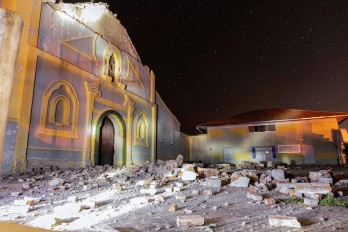
Magnitude 4.8 earthquake strikes southern Spain, injuring 3 and damaging buildings

At least three people have suffered minor injuries, and several buildings have been damaged after a magnitude 4.8 earthquake struck southern Spain on Tuesday morning. Andalusian regional official Antonio Sanz said one of the injured, a minor, was taken to hospital.
According to Spain's National Geographic Institute (IGN), the earthquake occurred at 10:37 local time (08:37 GMT) at a depth of less than 10 km, around 10 km (six miles) south of the historic city of Granada. The epicentre was initially placed near the town of Alhendín before specialists revised the location to neighbouring Gójar; Reuters reported the main shock at magnitude 4.7. The IGN said it was the latest in a series of very shallow tremors that have affected the region since last Friday and have been widely felt by residents. It followed a stronger earthquake, initially reported at magnitude 5.0, that shook Granada in the early hours of Saturday.
The tremor caused concern among residents, with many people leaving their homes and gathering in the streets because they feared further, stronger aftershocks. Falling debris also damaged several vehicles, while some museums, administrative buildings and sports facilities were temporarily closed. Primary health centres remained open.
Residents described the shaking as unusually strong. Alfonso Malpica, who felt his ground-floor flat in Granada shaking, told the Spanish newspaper El País that the tremor was stronger than the occasional quakes people in the area have grown used to. Cristina Ruiz López, a laboratory worker who was in a Granada supermarket when the earthquake hit, described the experience as terrifying, saying that objects came crashing down around her.
The Alhambra, a UNESCO World Heritage Site renowned for its medieval Islamic architecture, was among the sites affected. Tourist access to parts of the hilltop complex was restricted: the Alcazaba, its oldest section, was evacuated, and access to the Nasrid Palaces was suspended. Site administrators said the monument would remain closed for the rest of the afternoon while their team assessed the situation. The Alhambra received 2.7 million visitors last year, making it one of Spain's most visited landmarks.
Granada's metro system also introduced temporary safety measures, reducing train speeds to 30 km/h (19 mph) as a precaution while checks were carried out.
Sources: bbc.com, reutersconnect.com, reuters.com
Media
- Spain Hit by Powerful M4.8 Earthquake!
- BREAKING: Spain Earthquake, Granada Rocked by 4.8 Quake as Cracks and Falling Debris Reported
Want to read more like this story?

The largest tunnel boring machine (TBM) in the world finished drilling underneath Seattle
Jun, 22, 2017 | NewsThe tunnel will become a double-decker highway, scheduled to open in 2019 It was in April of...

4.1 magnitude earthquake in Nice, France raises concerns among authorities
Mar, 18, 2025 | NewsOn Tuesday, March 18, a 4.1-magnitude earthquake struck Nice, France, at approximately 6:45 p.m. lo...

The tallest structure in Indiana: 1,132 feet tall
Jul, 20, 2023 | NewsCities and nations have engaged in a competitive race, vying to outdo one another by constructing m...

The first building in Toronto, Canada to exceed 100 storeys.
Nov, 08, 2022 | NewsToronto is in the midst of a historic skyscraper race, as two developments duke it out for the titl...

Sinkholes Found Near Lotte World Tower
Aug, 01, 2014 | NewsFive years into construction on the Lotte World Tower, the developers of the skyscraper have receive...

Europe's 'longest bridge' which cost £746.5m to build
Oct, 06, 2024 | NewsThe Vasco da Gama Bridge, located in Lisbon, Portugal, is the longest bridge in Europe. Its length...

World’s Tallest Residential Building Under Construction
Feb, 06, 2014 | NewsConstruction is currently reaching over 600 feet on the 432 Park Avenue residential building in New...

Structural design for Phase 2 of the Gurugram Metro stations begin
Oct, 24, 2025 | NewsThe structural design work for Phase 2 of the Gurugram Metro project is presently in progress under...

Spectacular interchanges around the world
Jun, 20, 2018 | NewsCheck these engineering marvels, built to provide solutions to chronic traffic congestion problems...
Trending

Building walls with demolition waste - the poetry of Cyclopean concrete


Revolutionary glass bridge exhibit at the Corning Museum of Glass

SkyCiv Engineering release new Mobile App


World Bank estimates Venezuela's earthquake losses at $19.6 Billion

Aman brings signature luxury to Singapore's first supertall skyscraper