Apartment building collapse in Athens (Greece) sparks concern over excavation safety
- Jun, 30, 2026
- Damage (Structural) Load Factors Structural Failures Underground Structures Other Structural Concrete Structures Structural Stability Structural Loads Structural Behavior News On Failures News On Natural Disasters / Failures Other News
- Greece, Athens
- Authored by: thestructuralengineer.info
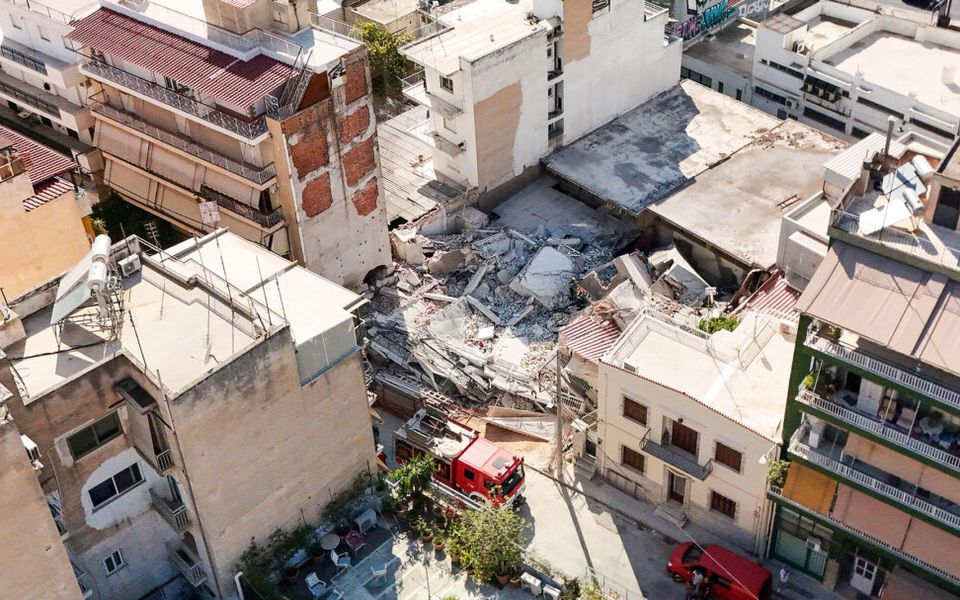
The collapse of a four-story apartment building at 22 Alkminis Street in Athens’ Petralona neighborhood on Tuesday, June 30, has left residents stunned and raised serious concerns among engineers about construction safety during excavation works. While investigators have not yet identified the official cause, many experienced civil engineers believe the incident is unlikely to have happened without significant failures in the excavation process at the neighboring construction site.
According to several engineers, the available evidence suggests that the excavation carried out for the basement and foundations of a new building may have destabilized the adjacent apartment block. They also argue that the stability of the local ground is often assumed to be better than it is.
"Buildings do not simply collapse," said civil engineer Giannis Christakis, who has nearly four decades of professional experience. He explained that while multiple factors can contribute to such an incident, several failures generally must occur at the same time before a building gives way. Christakis noted that most buildings in Athens are constructed under a continuous building system, where structures occupy nearly the entire plot and are built directly next to neighboring properties. This means excavation work often takes place only a short distance from existing buildings.
He stressed that, with the proper excavation methods and adequate ground support, construction can be carried out safely even in difficult soil conditions. In his view, the ground itself is rarely the main issue. Instead, he believes that most problems arise during construction, particularly when design errors or poor engineering judgments go unnoticed by supervising engineers or contractors as excavation progresses.
The incident has also reignited discussion about Greece's approach to geotechnical investigations. Civil engineer Aggelos Barbalios explained that geotechnical studies are not mandatory for every construction project but only in specific cases. When such studies identify potential risks, engineers are required to prepare temporary support designs to protect neighboring buildings and nearby roads throughout the excavation phase.
For typical residential developments in areas where soil conditions are already well understood, Barbalios said engineers often rely on their professional experience to assess the site and determine the appropriate safety measures.
One of the most common methods used to protect adjacent buildings is the construction of reinforced concrete retaining structures known in Greece as doulapia. These are built in alternating sections along the excavation boundary, allowing each concrete section to gain strength before the next is constructed. Once the retaining wall is completed, excavation for the basement can proceed with significantly greater stability.
More challenging sites may require additional stabilization methods, such as bored piles or sprayed concrete (gunite), to prevent soil movement. Engineers also emphasize that once excavation is complete, construction of the first reinforced concrete basement slab should begin as quickly as possible to stabilize the site.
Christakis added that practical experience remains especially important because detailed information about underground conditions is not available for every part of Athens. In some locations, consultation with specialist geotechnical engineers becomes essential.
He pointed out that experienced engineers are generally familiar with areas that present greater challenges, particularly locations built over former stream beds, including parts of Kypseli, Fokionos Negri Street and Alexandras Avenue. Even so, he noted that much of Attica benefits from rocky or semi-rocky ground, which generally offers better stability.
The way the Petralona building collapsed has also drawn attention within the engineering community. Based on photographs and videos from the scene, civil engineer Evlalia Lamprinou observed that the building appeared to lean before finally collapsing. Although she could not determine whether this reflected the quality of the original construction, she said the gradual movement gave residents enough time to evacuate, preventing injuries. She explained that this gradual failure is consistent with the objective of modern structural design, which aims to allow buildings to deform rather than collapse suddenly, even during earthquakes.
Lamprinou believes the site may have lacked both a proper geotechnical assessment and an adequate temporary retaining design. In her opinion, one side of the neighboring building was effectively left unsupported during excavation, while the associated risks were underestimated.
Engineers say similar precautions are equally important during demolition projects. Alexandros Chrimatopoulos, who has extensive experience in demolition work, said neighboring buildings should always be supported because their structural condition is often unknown.
Even when collapses do not result in injuries, they frequently lead to lengthy legal disputes. Christakis recalled serving as an expert witness in a similar case involving a three-story building from the 1950s. Excavation for a neighboring seven-story development with two basement levels began without sufficient protective measures.
On Christmas Eve, the older building began to tilt. Although it did not collapse immediately and no one was injured, it ultimately had to be demolished. The owner then became involved in a prolonged legal battle after the developer denied responsibility and claimed that poor maintenance of the building's foundations had caused the failure. Several years later, the case remains in court, and the owner has still not received compensation, despite the neighboring development having already been completed.
The collapsed building in Petralona also has a long history. The adjacent plots were originally part of a larger property allocated in 1927 before being divided into smaller parcels in 1950. A two-story building with a ground-floor shop and warehouse was constructed at 20 Alkminis Street in 1956, while the apartment building that eventually collapsed was built under a planning permit issued in 1973. Over the following years, additional floors were added until the structure reached four stories.
Authorities have not yet released the results of their investigation. Until the official findings become available, engineers stress that any explanation for the collapse remains preliminary.
Sources: ekathimerini.com, reuters.com, euronews.com
Media
- Athens Building Collapse | Rescue Dogs Search Rubble As Crews Race Against Time | VERTEX
- Search for Survivors After 4-Story Apartment Building Collapses in Athens
Want to read more like this story?

27 Dead in Two India Building Collapses
Jul, 01, 2014 | NewsTwo deadly building collapses occurred in India this past weekend claiming the lives of 27 people. T...

4 Dead in Nigerian Building Collapse
Nov, 09, 2013 | NewsA four-story residential building under construction in one of the most expensive communities in Afr...

Building collapses in Italy: the second failure in few days!
Sep, 28, 2016 | NewsLast Thursday, a collapse of a four-story building occurred in the Ponte Milvio area of northern Rom...

A 7-storey building collapsed in Istanbul, Turkey
Jun, 27, 2024 | NewsOn June 27, a seven-storey building collapsed in Istanbul, Turkey. The incident occurred in the Zaf...

A four-storey building collapsed after efforts to rectify its imbalance in South Kolkata
Jan, 15, 2025 | NewsOn Tuesday January 14 around 3:05 p.m. local time a four-storey building gave way and fell onto a o...

Miami: 12-storey building collapses, dozens under the debris
Jun, 28, 2021 | NewsA 12-storey residential building north of Miami has collapsed, trapping people under a pile of rubb...

16 fatalities following building failure in Pakistan
Mar, 05, 2020 | NewsAt least 16 people have been reported dead after a building failure in Karachi, the largest city of...

8-story building gave way in Nigeria: At least 2 casualties
Apr, 30, 2020 | NewsTwo people have been reported dead after an 8-story building collapsed in the city of Owerri, Imo S...

Internal collapse of 5-story building in Manhattan
Jan, 04, 2019 | NewsAn uninhabited 5-story building internally collapsed on December 21, 2018. The building is locate...
Trending


4.1 magnitude earthquake in Nice, France raises concerns among authorities

The tallest structure in Indiana: 1,132 feet tall

The first building in Toronto, Canada to exceed 100 storeys.

Sinkholes Found Near Lotte World Tower

Aman brings signature luxury to Singapore's first supertall skyscraper
World Bank estimates Venezuela's earthquake losses at $19.6 Billion