Ningbo–Xiangshan suburban railway project: Graphene coating aims to extend the service life of Xiangshan Port bridge

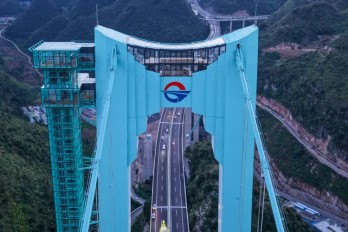
As part of the wider project in the region, a new protective technology is being used on the Xiangshan Port railway bridge in eastern China. The engineers have applied graphene-enhanced coating to help extend the life of the steel structure. This project addresses one of the main difficulties associated with coastal infrastructure: protecting structural materials from continuous exposure to the marine environment.
The bridge which they applied the material is crossing Xiangshan Port in Zhejiang Province, while its measure is approximately 8.28 kilometers. This bridge is belonging to the Ningbo–Xiangshan suburban railway and is notable for its long-span cable-stayed configuration and ballastless track. The railway will provide a faster connection between central Ningbo and the southern coastal part of the city.
It should be noted that maintaining steel structures in coastal locations is challenging as the salt carried through the air, simultaneously with high humidity and ultraviolet radiation, can gradually weaken protective layers and leave the underlying metal vulnerable to corrosion. If this deterioration is not controlled, more frequent maintenance may be required to preserve the structure’s condition.
The coating applied to the bridge was developed by researchers from the Ningbo Institute of Materials Technology and Engineering, part of the Chinese Academy of Sciences, together with a company originating from the institute. Graphene has been incorporated into the protective material to improve its resistance to harsh environmental conditions. The resulting coating adheres strongly to steel and provides protection against salt exposure, helping limit corrosion in the bridge’s principal steel elements.
In addition, the developer suggests that the new material can double the bridge’s lifetime compared with conventional anti-corrosion coatings. If this performance is maintained in practice, the technology could reduce the frequency of repair work, lower maintenance expenditure and minimize the safety concerns associated with deteriorating protective systems.
Moreover, the bridge project is not the technology’s only application as the same coating has been used on the Jakarta–Bandung High-Speed Railway in Indonesia and at a dual-fuel power station in Cambodia. According to the research institute, potential future uses include marine infrastructure, high-performance industrial equipment and aerospace applications, where materials must withstand demanding operating environments.
In all, the large-scale use of the graphene-enhanced coating on the Xiangshan Port bridge is a significant example of how advanced materials can be applied to railway infrastructure. Therefore, by improving protection against corrosion, the technology aims to reduce the long-term maintenance burden and help preserve the performance of a major transport link.
Sources: graphene-info.com, english.cas.cn, lovegraphene.com, news.cgtn.com
Want to read more like this story?

China: Hangzhou Bay cross-sea railway bridge reaches major construction milestone
Oct, 23, 2026 | NewsThe southern navigation channel bridge of the Hangzhou Bay Cross-Sea Railway Bridge reached a major...

Croatia to construct a new bridge from the mainland to Krk Island
Mar, 07, 2024 | NewsIn order to manage the traffic congestion on the aging (opened on July 19, 1980) Tito Bridge, a new...

World's highest railway bridge to open in J&K
Mar, 26, 2023 | NewsWith the upcoming opening of the tallest railway bridge in the world crossing the Chenab River, Jam...

Types of bridges
Jun, 01, 2023 | EducationArch Bridge An arch bridge is a type of bridge that uses a curved, semi-circular structure, kno...

Vermont Uses ‘Bridge in a Backpack’ Technology to Speed Up Projects
Sep, 10, 2014 | NewsA new bridge project began last month in Fairfield, Vermont that uses new technology to reduce const...

A smarter fire-resistant coating for safer steel structures
Apr, 27, 2026 | NewsFire safety remains a critical consideration across multiple sectors, including construction and ene...

Bridges
Jan, 01, 2019 | EducationA bridge is the structure that allows the transition from one position (A) to another (B). The a...

Two new bridges are now open to the public in Toronto's Port
Jan, 24, 2024 | NewsTwo new bridges in Toronto's Port Lands area, called the Cherry Street North and Commissioners Stre...

World's most frightening bridges to cross: Part 1
Mar, 20, 2020 | NewsBridges are structures that enable crossings over physical barriers including rivers, valleys and c...
Trending

Spectacular interchanges around the world

Cairo, Egypt: Building collapse caused 6 casualties while 7 others were injured

Severe storms and possible tornadoes cause widespread damage across North Carolina
Glass cafe at 2,600 feet in the air: it opens on world's tallest bridge

New AI system identifies multiple defects in concrete bridges using photographs
MIT engineers test new fabric-cast concrete beams that require less concrete