
New AI system identifies multiple defects in concrete bridges using photographs
- Nov, 06, 2026
- Bridge Management Bridge Abutments Bridge Design Bridges Damage (Structural) Structural Failures Structural Health Monitoring Structure Types Concrete Structures Sustainable Development Non Destructive Testing Repair And Retrofit Of Structures Soft Computing Applications News On Projects / Industry Other News
- Authored by: thestructuralengineer.info
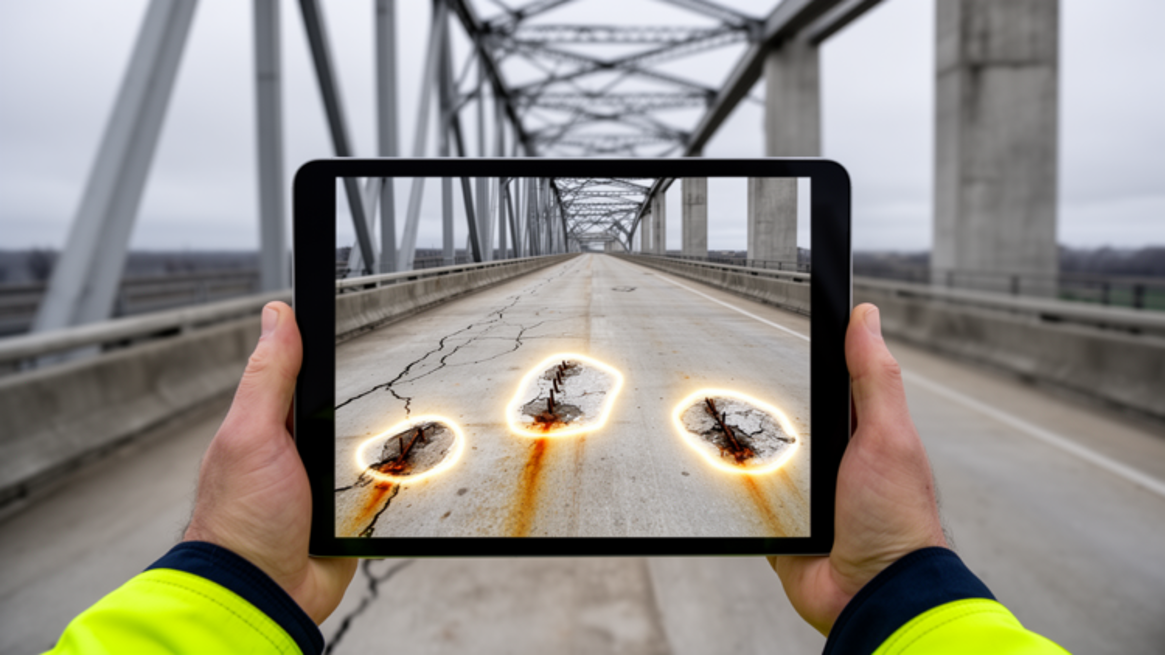
A major matter for the engineers is that inspecting concrete bridges is not always straightforward, as it is very common several types of damage to be developed in the same area. Cracks, exposed steel reinforcement, corrosion stains and deteriorating concrete can appear together, making it difficult for automated systems to distinguish between individual defects. Therefore, researchers have now developed an artificial intelligence approach that can recognize multiple forms of damage from a single photograph, potentially improving how bridge inspections are carried out.
Specifically, Jamiu Lateef and Xiong Yu published an article in AI in Civil Engineering to explore this matter. They suggest that it is not necessary to treat every photograph as an example of one specific defect, but a classification system can be used to assign several labels to the same image. This reflects conditions commonly encountered during inspections, where a concrete surface may show more than one sign of deterioration.
The research was based on CODEBRIM, a collection of photographs taken at 30 bridges in varying conditions. The dataset covers cracks, spalling, exposed reinforcement bars, efflorescence and corrosion staining, as well as concrete surfaces without visible damage.
Before developing the models, the team examined the available photographs and excluded images that were blurred or of insufficient quality. The remaining 7,729 images were standardised to a resolution of 128 × 128 pixels and separated into training, validation and testing groups.
Three existing image recognition networks were selected for comparison: VGG16, ResNet50 and EfficientNetB0. Each had already been trained to recognise features in general images, but the researchers wanted to determine how effectively these networks could be adapted to the more specific task of identifying concrete deterioration.
They tested two approaches. Under the first, the networks' original feature extraction layers remained unchanged, with only the final classification components trained on the bridge photographs. Under the second, selected layers within the networks were also retrained to better recognise the appearance of different defects.
The difference was significant. Allowing the models to learn additional features from the bridge images improved their performance across the measures examined in the study.
Specifically, it was concluded that VGG16 produced the best overall classification results, because of its ability to correctly identifying every applicable defect category in 84% of the test photographs. In addition, the model achieved an F1-score of 85.2%, a measure that considers both how accurately a model identifies damage and how often it overlooks defects that are present.
On the other hand, ResNet50 performed better in certain other areas, particularly when estimating and ranking the likelihood of different defect types. In addition, the EfficientNetB0, delivered also competitive results with a smaller model, making it potentially suitable for situations where computing resources are limited.
Moreover, the results also revealed differences in how easily particular defects could be identified. Cracks and exposed reinforcement bars were generally recognized with greater accuracy, while spalling was sometimes confused with naturally rough or uneven concrete surfaces.
In addition, efflorescence and corrosion staining proved more challenging because efflorescence was less common in the training images and often lacked clearly defined visual features. Meanwhile, corrosion stains were also difficult to distinguish, especially when they appeared alongside more noticeable damage such as spalling or exposed reinforcement.
It should be noted that the researchers carried out an additional experiment using 1,885 artificially generated images to assess how the models performed on photographs that differed from those used during training. Despite that the accuracy declined across all three networks, VGG16 correctly identified the complete set of labels in 73.2% of these images, while ResNet50 recorded the highest F1-score at 73.5%.
On the other hand, another part of the study examined how the models reached their conclusions. For this matter the researchers used a visualization method known as Grad-CAM, to identify the areas of each photograph that influenced the classification results. In that case, the analysis showed that the fine-tuned VGG16 model was directing its attention towards features associated with concrete damage.
The researchers acknowledge that further testing will be necessary before the approach can be relied upon across a wider range of bridges. The number of available images is relatively small, some defects appear much less frequently than others, and real inspection photographs can vary considerably depending on lighting, surface condition and other factors.
They suggest that future work should examine performance across different bridges and locations, improve the handling of less frequently observed defects and develop ways to identify the exact position and extent of damage.
Although the technology is still being evaluated, the findings indicate that adapting existing image recognition networks to bridge-specific conditions can substantially improve their ability to distinguish between overlapping defects. Such systems could eventually help engineers organise inspection findings, follow the progression of deterioration and make more informed decisions about maintenance and repairs.
Sources: bioengineer.org, scienmag.com
Want to read more like this story?

Drones and AI can reduce risks in corroded bridges
Oct, 15, 2024 | NewsToday, corroded bridges pose significant safety risks, but advances in drone and AI technology are...

AI tool turns drone images into street-level views to speed up earthquake response assessment
Mar, 25, 2026 | NewsResearchers have developed a new artificial intelligence (AI) tool designed to support rapid post-e...
PolyU unveils multi-tier AI bridge inspection system deployed on 11 Hong Kong bridges
Nov, 25, 2025 | NewsA research team at The Hong Kong Polytechnic University has developed a multi-tier intelligent brid...

The longest 3D-printed concrete bicycle bridge
Sep, 09, 2021 | NewsThe Dutch city of Nijmegen has now the longest concrete 3D-bicycle bridge in the world. The length...

Concrete damage based on 4 crucial factors
Feb, 01, 2024 | NewsConcrete often sustains damage due to various factors, either environmental or mechanical. In the f...
Topology optimization for manufacturable 3D-printed concrete structures
Jul, 15, 2026 | NewsConcrete is the most used construction material worldwide, but its production is also one of the lar...

Novel computing model can detect structural damage with no physical intervention
Jan, 31, 2024 | NewsResearchers from Drexel University in Pennsylvania have developed a system that is believed to effi...

Researchers developed AI-based algorithms for real-time structural assessment of bridges
Sep, 13, 2023 | NewsBridges play a crucial role in India's infrastructure, with approximately 13,500 of them spread acr...
AI and virtual reality to monitor the structural safety of buildings and bridges
Nov, 08, 2023 | NewsThe structural health and safety of a nation's bridges and buildings is crucial for preventing disa...
Trending

Spectacular interchanges around the world

Severe storms and possible tornadoes cause widespread damage across North Carolina
Glass cafe at 2,600 feet in the air: it opens on world's tallest bridge

The Leaning Tower of Pisa: Ingenious design and ongoing stability efforts

Athens, Greece: Building collapsed after explosion

Cairo, Egypt: Building collapse caused 6 casualties while 7 others were injured

