
How X1 Wind Accelerated DNV Verification for Floating Wind Platform with Up to 1.2 Million Elements Sponsored

Verifying a floating wind platform to DNV rules meant eight engineering hours per column — repeated after every design iteration. X1 Wind moved the buckling and yielding checks into a reusable workflow and brought that down to one or two hours.
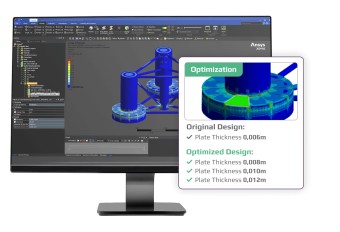
X1 Wind has verified its X100 floating wind prototype using Ansys together with SDC for Ansys, automating DNV buckling and yielding checks across finite element models of up to 1.2 million elements.
The X100 is a pre-commercial platform built to validate X1 Wind's PivotBuoy technology at full scale. Its tripod design combines single point mooring with a tension leg mooring system and a downwind configuration that weathervanes passively, cutting primary steel weight by up to half compared with conventional floating platforms. The prototype has received a Statement of Compliance for Basic Design from DNV and will be deployed at the PLEMCAT test site off Catalonia, Spain.
Running the analysis was never the bottleneck — post-processing was. A single column required roughly eight engineering hours: five to six to extract σx and σy results from Ansys, about an hour for panel shear stresses, and half an hour of file preparation. Each structure carried some 12 to 15 shell panels checked to DNV-RP-C202 and 8 to 10 plate panels checked to DNV-RP-C201. Every change to plate thickness, reinforcement or unsupported span meant rerunning Ansys and repeating most of that work.
By connecting SDC for Ansys directly to the existing Ansys results, the engineering team built the checks once and reused them. Plate and shell buckling to DNV-RP-C201 and RP-C202 now run alongside a custom yielding check comparing von Mises and shear stresses against material limits. Around 120 load cases are processed in a single workflow, with load-case envelopes identifying the governing combinations instead of requiring case-by-case review.
A column buckling check now takes one to two hours. More importantly, design iterations no longer trigger a fresh manual cycle: the structure is modified, Ansys is rerun, and the existing checks update against the new results. The same procedure held consistently across models ranging from about 300,000 to 1.2 million elements — and gave engineers a clearer view of actual structural margin than their previous, more conservative manual checks.
Read the full case study: sdcverifier.com/customer-stories/x1-wind-floating-wind-dnv-verification/
Want to read more like this story?

SDC Verifier 2026 R2 Expands Structural Verification for Offshore, Marine, and Complex Engineering Projects
Sep, 16, 2026 | NewsSDC Verifier 2026 R2 expands structural verification with new offshore and marine standards, multiax...
SDC for Ansys
Dec, 13, 2024 | SoftwareWind engineering
Sep, 07, 2023 | EducationWind engineering is a branch of engineering that focuses on studying the effects of wind on various...

What’s New in SDC Verifier 2025 R2
Sep, 11, 2025 | EventThis webinar will present a new version of SDC Verifier, the advanced structural verification softw...
WoodWorks
Dec, 09, 2013 | Software
ATX Tower, Austin: Pioneering Performance-Based Wind Design in High-Rise Construction
Jun, 18, 2024 | NewsThe University of Texas at Austin designed the ATX Tower, the first high-rise to incorporate the Am...

FIN EC Concrete 3D
Nov, 05, 2013 | SoftwareWind tunnel
Sep, 07, 2023 | EducationConducting wind tunnel experiments, engineers or researchers can predict the behavior of a structu...

CivilFEM APPs for ANSYS Workbench
Feb, 05, 2026 | SoftwareTrending

Spectacular interchanges around the world

Severe storms and possible tornadoes cause widespread damage across North Carolina
Glass cafe at 2,600 feet in the air: it opens on world's tallest bridge

The Leaning Tower of Pisa: Ingenious design and ongoing stability efforts

Athens, Greece: Building collapsed after explosion

Cairo, Egypt: Building collapse caused 6 casualties while 7 others were injured


LEAVE A COMMENT