
MIT announced new technology that can turn discarded plastic into large structural building components
- Sep, 21, 2026
- Bridge Management Bridge Abutments Bridge Design Bridges Sustainable Development Structural Design Multiscale Methods Structural Optimization Structural Systems Structure Types Composite Structures Other Structural News On Projects / Industry Other News
- United States, Massachusetts
- Authored by: thestructuralengineer.info

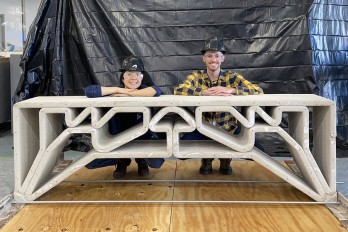
A new breakthrough construction technology has been developed by MIT, as they have managed to incorporate recycled plastic into actual infrastructure outside the laboratory. With the collaboration of Atlas Building Composites, they have developed a robotic additive-manufacturing system that specifically manages to turn discarded plastic into large structural building components.
The technology recently reached a significant milestone when Atlas supplied composite trusses for a 40-foot pedestrian bridge commissioned by the U.S. Army Corps of Engineers in a Massachusetts wetland.
According to MIT researchers, the bridge was installed in less than a day, highlighting the potential of digitally fabricated components to shorten both manufacturing and construction timelines. Therefore, this technology enables Atlas to produce large structural elements, including foundations, decking components, and trusses.

Researchers described the process step by step and noted that to produce the final product, they use single-use plastic, which is shredded and melted before being reinforced with fiberglass. The result is a composite that is then deposited using a robotic additive-manufacturing system controlled by artificial intelligence. Hence, they do not need to depend on traditional factories to produce standardized building components and then transport them over long distances, because Atlas's system allows materials to be manufactured digitally and adapted to local resources and the specific needs of each project.
Moreover, the researchers have also shown that these recycled composites can have significant structural strength. Specifically, in one test, a digitally manufactured truss was produced in less than 13 minutes and supported more than 4,000 pounds. This suggests that recycled polymer composites could potentially be used for structural purposes, rather than being limited to decorative or non-structural applications.
The goal of the project was to determine whether this method is practical and financially viable on a larger scale, because at the end this could alter how construction materials are produced and distributed in the future. With this method, transportation time for the components could be reduced, as materials could be manufactured closer to construction sites using waste collected from the surrounding area.
It should be noted that although Atlas has reported that the expected production rate is approximately 150 to 200 pounds of material per hour, these figures are based on the company's own projections and should be distinguished from independently verified results.
However, although this method has several benefits, some questions have been raised about the final product. For example, adding fiberglass to the recycled plastic introduces another material into the composite, which could increase carbon emissions. It is also not yet known whether the final product can be recycled once a building reaches the end of its life. Therefore, the long-term performance of these materials under different environmental conditions must be tested and independently verified as the technology develops.

In addition, structural applications also need to meet strict requirements related to fire safety, building codes, durability, moisture, maintenance, and repair.
The importance of Atlas's work goes beyond simply finding a new way to reuse plastic. The technology brings together several developing fields, including recycled materials, robotic manufacturing, artificial intelligence, computational design, and local production.
The pedestrian bridge in Massachusetts offers an early example of how these technologies can be used in a real construction project rather than remaining in the research environment. The bigger challenge now is whether the system can be scaled up and used for larger construction projects while remaining affordable, durable, and compliant with building regulations.
For architects and designers, the key question is therefore not only whether plastic waste can be transformed into a building material. It is also whether robotic manufacturing can help create a new construction model where local waste becomes a source of structural material and production takes place closer to the building site.
This approach changes the way we think about recycling. Instead of treating it as a separate technical process, it encourages architects and engineers to consider the entire lifecycle of a material. From discarded plastic bottles to pedestrian bridges, circular construction requires an understanding of where materials come from, how they are processed, how they perform over time, and what happens to them when a structure is no longer in use.
Sources: parametric-architecture.com, meche.mit.edu
Media
- MIT alumni spinout 3D prints plastic building materials 1080p
Want to read more like this story?

10 state-of-the-art sustainable materials that will alter construction industry
Jun, 10, 2024 | NewsIn 2024, sustainable materials become state-of-the-art in construction since the construction indus...
Composite structures
Sep, 07, 2023 | EducationComposite structures refer to constructions that are composed of two or more distinct materials co...

Sustainable materials can be used in construction to decrease environmental pollution
Apr, 30, 2024 | NewsEfforts to reduce emissions in the building sector typically focus on operational aspects like heat...

Designing a skyscraper completely made out of plastic
May, 10, 2019 | NewsArchitects Jaemin Seo and Sanghoon Park from the U.S. designed a fin-shaped skyscraper that is inspi...

New method to transform construction waste into useful materials
Dec, 07, 2018 | NewsA group of German researchers has found a way to manipulate construction waste by turning them into...

Organic London Skyscraper Concept Unveiled
Jul, 10, 2014 | NewsFrench architectural firm Chartier-Corbasson has joined in on the green structures trend by unveilin...

Robotics technology transforms current construction industry
Sep, 14, 2018 | NewsResearchers at Purdue Polytechnic Institute are currently trying to lay the foundation for robotics...
Topology optimization for manufacturable 3D-printed concrete structures
Jul, 15, 2026 | NewsConcrete is the most used construction material worldwide, but its production is also one of the lar...

Steel or Timber? Carbon footprint of truss structures can be reduced with the aid of new studies
Nov, 29, 2021 | NewsBuildings contribute significantly to global warming, not just in their ongoing operations but in t...
Trending

Spectacular interchanges around the world

Nine fatalities after building collapses in Western India

7.1-magnitude quake damages historic Kumamoto Castle under restoration

Powerful earthquake near Naples injures 26 and causes widespread disruption

Ten of the world’s most famous concrete structures

Brazil is building Latin America’s longest sea bridge

